
Comprehensive Guide to SEM: Mastering Paid Search Advertising and Google Ads Campaigns for Effective PPC Management
Search Engine Marketing (SEM) is a powerful digital marketing strategy that leverages paid search advertising to enhance online visibility and drive targeted traffic to websites. This comprehensive guide will delve into the intricacies of SEM, focusing on Google Ads campaigns and effective PPC management techniques. Readers will learn how SEM operates, the essential components involved, and the best practices for optimizing campaigns to achieve maximum return on investment (ROI). Many businesses struggle to navigate the complexities of paid search, often leading to wasted budgets and missed opportunities. By understanding the mechanisms of SEM and implementing proven strategies, marketers can significantly improve their campaign performance. This article will cover the fundamentals of SEM, the setup and optimization of Google Ads, key bidding strategies, conversion tracking, remarketing, and the use of analytics for continuous improvement.
Indeed, the evolution and comprehensive capabilities of Google Ads are central to modern digital marketing strategies, as highlighted by recent research.
Google Ads: Targeting, Analytics & ROI Chapter 42 delves into the dynamic realm of Google Ads, formerly known as Google AdWords, a cornerstone platform in digital marketing. Originally launched in 2000 and rebranded in 2018, Google Ads offers advertisers a robust suite of tools to promote products and services across Google’s extensive network, encompassing search results, websites, YouTube, and apps. Key to its effectiveness is precise audience targeting based on keywords, demographics, and user behavior, maximizing ad relevance and engagement. Advertisers bid on keywords, ensuring that relevant ads appear when users search, thereby driving clicks and conversions. The platform also provides comprehensive analytics to monitor campaign performance, optimize strategies, and enhance ROI. Using google ads in digital marketing, K Solberg Söilen, 2024
What is SEM and How Does Paid Search Advertising Work?
Search Engine Marketing (SEM) encompasses various strategies aimed at increasing a website's visibility on search engine results pages (SERPs) through paid advertising. This approach primarily involves using platforms like Google Ads to create targeted ads that appear when users search for specific keywords. The core components of SEM include keyword research, ad creation, bidding strategies, and performance tracking, all of which work together to drive traffic and conversions.
Defining SEM and Its Core Components
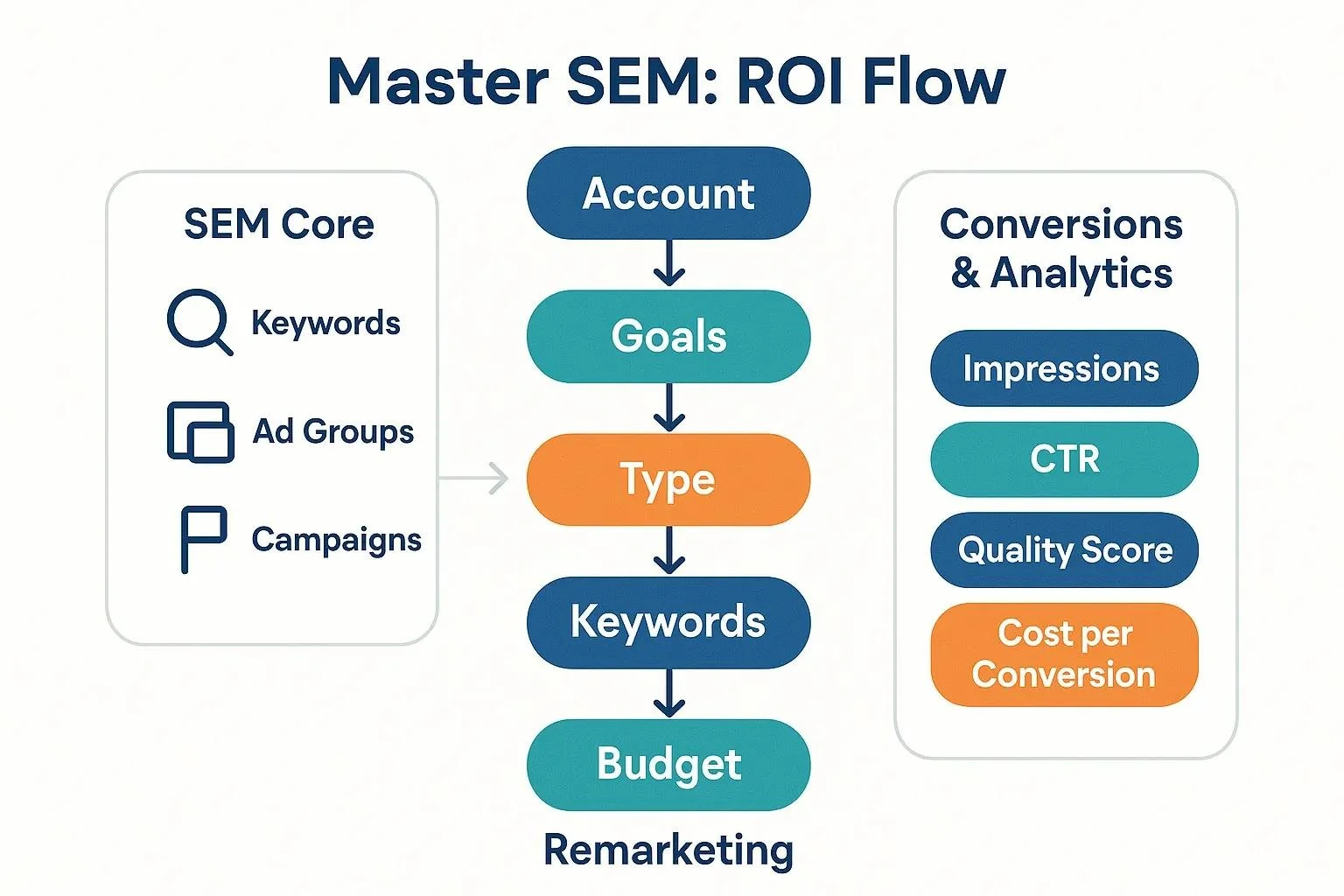
SEM is defined as a form of digital marketing that promotes websites by increasing their visibility in search engine results through paid advertising. The core components of SEM include:
Keywords: The terms users enter into search engines, which are crucial for targeting ads effectively.
Ad Groups: Collections of ads that share similar keywords, allowing for organized campaign management.
Campaigns: The overarching structure that contains ad groups and defines the budget and targeting settings.
Understanding these components is essential for creating effective SEM strategies that resonate with target audiences.
How Paid Search Advertising Drives Online Visibility
Paid search advertising significantly enhances online visibility by placing ads at the top of search results, where they are more likely to be seen by users. Research indicates that ads can increase click-through rates (CTR) by significant margins compared to organic listings. This visibility not only drives traffic but also improves brand recognition and credibility. Case studies show that businesses utilizing paid search advertising experience a substantial increase in website visits and conversions, making it a vital component of any digital marketing strategy.
How to Set Up and Optimize Google Ads Campaigns for Maximum ROI
Setting up and optimizing Google Ads campaigns is crucial for achieving maximum ROI. A well-structured campaign can lead to increased visibility, higher CTR, and ultimately, more conversions.
Achieving a strong return on investment through Google Ads campaigns is increasingly reliant on sophisticated data-driven techniques, as recent studies emphasize.
Data-Driven Google Ads Optimization for ROI Google Ads is a powerful tool that helps marketers to grow online businesses. It is aimed to develop the growth of business campaigns and E-Commerce sales we have analyzed and implemented the Data Driven Digital Marketing strategies to ensure effective positioning of marketing strategies, organization's websites, and other online resources. The main purpose of running the Google Ads is to analyze the Return of Investment (ROI) and to implement the Google Ad words Campaign in digital marketing. By combining the data analytics (data science) and digital marketing we can meet out the various problems and business strategies. The main goal is to measure the performance of the ads in terms of reaches, engagements, metrics, and reactions, as well as to analyze the effectiveness of Google ad Campaign in generating orders, as well as to identify a possible target group for the brand and promote digital branding to achieve a profitable Return on Investment (ROI). To optimize google ad campaign using data driven technique, T Avudaiappan, 2023
Step-by-Step Google Ads Campaign Setup Guide
To set up a Google Ads campaign effectively, follow these steps:
Create a Google Ads Account: Sign up for an account and set your billing information.
Define Your Campaign Goals: Determine whether your focus is on sales, leads, or website traffic.
Select Your Campaign Type: Choose between Search, Display, Shopping, or Video campaigns based on your objectives.
Conduct Keyword Research: Use tools like Google Keyword Planner to identify relevant keywords for your ads.
Set Your Budget and Bidding Strategy: Decide on a daily budget and choose a bidding strategy that aligns with your goals, such as Cost-Per-Click (CPC) or Target CPA.
By following these steps, marketers can create a solid foundation for their Google Ads campaigns.
Best Practices for Adwords Optimization and Ad Copywriting
Optimizing Google Ads involves continuous refinement of ad copy and targeting strategies. Here are some best practices:
Write Compelling Ad Copy: Use clear, concise language that highlights the unique selling points of your product or service.
Utilize Ad Extensions: Enhance your ads with additional information such as site links, callouts, and structured snippets to improve visibility and CTR.
A/B Test Your Ads: Regularly test different versions of your ads to determine which performs best, allowing for data-driven decisions.
Implementing these practices can lead to improved ad performance and higher conversion rates.
The continuous refinement of ad quality and performance metrics is paramount for successful Google Ads campaigns, a concept thoroughly explored in academic literature.
Google Ads Campaign Quality & Performance Optimization Despite the proliferation of digital advertising channels, Google Ads remains critical in digital marketing. A synthesised understanding of the specific impact of campaign quality in the Google Ads advertising ecosystem has received limited attention. This study addresses this research gap through a PRISMA-based systematic review of 49 peer-reviewed articles published between 2007 and 2024. The review identifies and categorises the main factors that define campaign quality, such as ad relevance, click-through rate (CTR), landing page experience, and conversion rate. We propose a comprehensive conceptual framework linking these dimensions to digital marketing results based on these findings. This paper also presents data-driven optimisation strategies to improve campaign performance. Finally, key metrics for evaluating the results of advertising campaigns were identified based on the existing literature. The proposed model is a practical guide for digital marketers to successfully implement advertising campaigns in Google Ads and evaluate their performance. The relationship between campaign quality and performance in Google Ads: a systematic review, M Shemshaki, 2025
What Are the Key PPC Bidding Strategies and How Do They Impact Campaign Performance?
PPC bidding strategies play a crucial role in determining how ads are displayed and how much advertisers pay for clicks. Understanding these strategies is essential for optimizing campaign performance.
Understanding CPC, CPM, and Automated Bidding Methods
The primary bidding strategies in PPC include:
Cost-Per-Click (CPC): Advertisers pay each time a user clicks on their ad. This method is effective for driving traffic.
Cost-Per-Mille (CPM): Advertisers pay for every 1,000 impressions their ad receives, suitable for brand awareness campaigns.
Automated Bidding: Google Ads offers automated bidding strategies that adjust bids in real-time based on the likelihood of conversion, optimizing for specific goals.
Each strategy has its advantages and is suited for different campaign objectives.
How Bidding Strategies Affect Ad Placement and Cost Efficiency
Bidding strategies directly impact ad placement and cost efficiency. Higher bids typically result in better ad placements, leading to increased visibility. However, it's essential to balance bid amounts with budget constraints to avoid overspending. Advertisers who utilize automated bidding strategies often achieve better cost efficiency and improved ad placements, maximizing their overall campaign performance.
How to Measure and Improve Conversion Rates in SEM Campaigns
Measuring and improving conversion rates is vital for the success of SEM campaigns. Understanding how to track conversions and analyze performance metrics can lead to actionable insights.
Tracking Conversions and Analyzing Performance Metrics
Tracking conversions involves setting up goals in Google Ads and using tools like Google Analytics to monitor user behavior. Key performance metrics to analyze include:
Conversion Rate: The percentage of users who complete a desired action after clicking on an ad.
Cost Per Conversion: The total cost of acquiring a conversion, helping to assess the efficiency of ad spend.
Click-Through Rate (CTR): The ratio of users who click on an ad compared to the total number of impressions.
By regularly analyzing these metrics, marketers can identify areas for improvement and optimize their campaigns accordingly.
Techniques for Conversion Rate Optimization in Paid Media Strategy
To enhance conversion rates, consider implementing the following techniques:
A/B Testing: Experiment with different landing pages and ad copies to determine which combinations yield the highest conversion rates.
Optimize Landing Pages: Ensure that landing pages are relevant to the ad content and provide a seamless user experience.
Utilize Retargeting: Re-engage users who have previously interacted with your ads but did not convert, increasing the chances of conversion.
These techniques can significantly improve the effectiveness of SEM campaigns.
What Role Does Remarketing and Display Advertising Play in SEM?
Remarketing and display advertising are essential components of a comprehensive SEM strategy, allowing businesses to re-engage potential customers.
Implementing Remarketing Campaigns to Re-Engage Audiences
Remarketing involves targeting users who have previously visited your website but did not convert. By displaying tailored ads to these users across various platforms, businesses can remind them of their interest and encourage them to return. Effective remarketing strategies include segmenting audiences based on their behavior and creating personalized ad content that resonates with their previous interactions.
Integrating Display Advertising with Paid Search for Omnichannel Success
Integrating display advertising with paid search campaigns can enhance overall marketing effectiveness. This approach allows businesses to reach users across multiple touchpoints, reinforcing brand messaging and increasing the likelihood of conversions. Companies employing an omnichannel strategy experience higher engagement rates and improved ROI, making it a valuable tactic in SEM.
How to Use SEM Analytics and Reporting to Enhance Campaign Effectiveness
Utilizing analytics and reporting tools is crucial for enhancing the effectiveness of SEM campaigns. By monitoring key metrics and leveraging data insights, marketers can make informed decisions.
Key Metrics to Monitor in SEM Analytics
When analyzing SEM performance, focus on the following key metrics:
Impressions: The number of times ads are displayed to users, indicating visibility.
CTR: A measure of how often users click on ads, reflecting ad relevance and effectiveness.
Quality Score: A Google Ads metric that assesses the quality and relevance of ads, keywords, and landing pages.
Monitoring these metrics helps marketers understand campaign performance and identify areas for improvement.
Leveraging Data Insights for Continuous Campaign Improvement
Data insights can drive continuous improvement in SEM campaigns. By analyzing performance trends and user behavior, marketers can adjust their strategies to optimize results. Techniques such as cohort analysis and funnel analysis can provide deeper insights into user interactions, enabling more effective targeting and messaging.
Metric
Description
Value
Impressions
Total ad displays
High visibility
CTR
Click-through rate
Indicates ad effectiveness
Quality Score
Assessment of ad relevance
Affects ad placement